How EN 60529 Defines IP Ratings for Dust and Water Protection
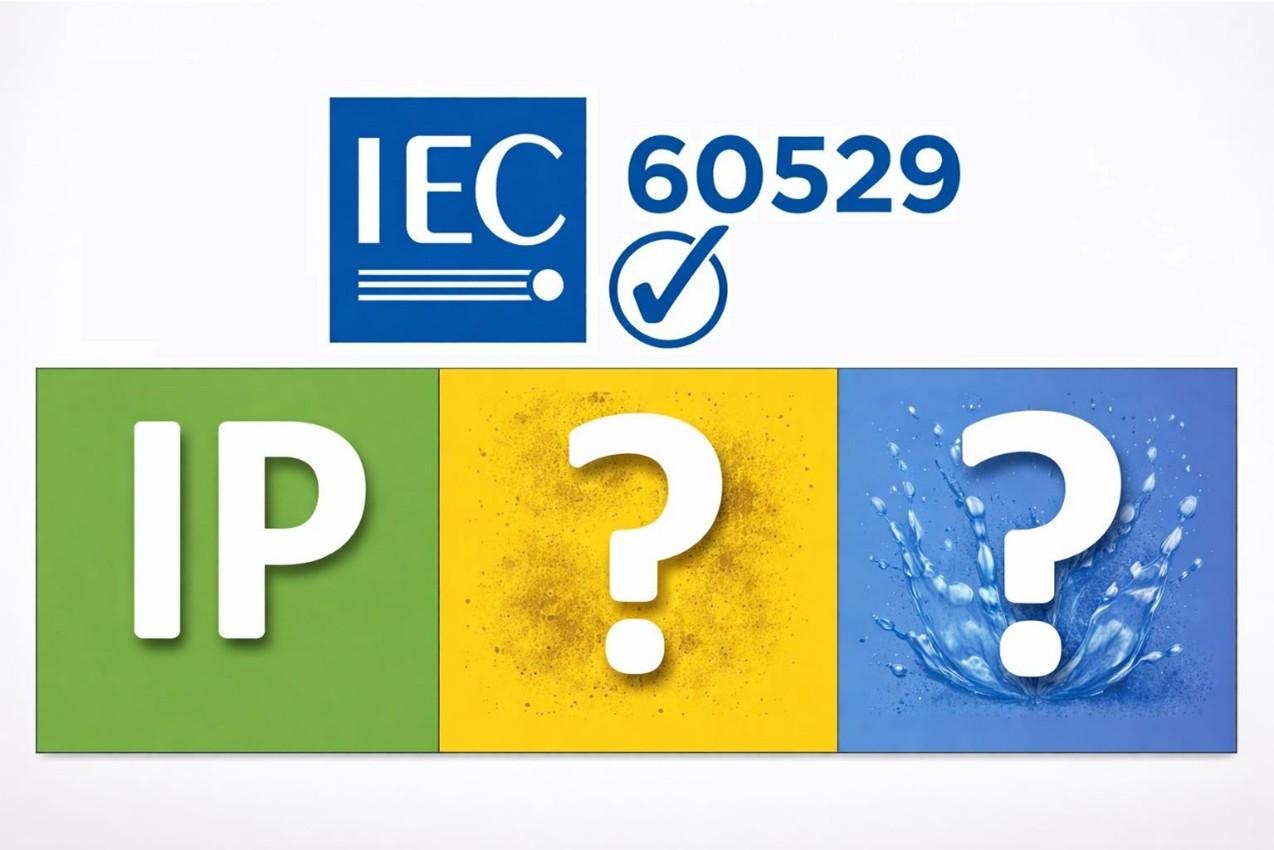
The IP rating of electrical equipment indicates the degree of protection provided by its enclosure against solid objects, including dust, and water ingress, as defined in EN 60529:2018 Degrees of protection provided by enclosures (IP Code). Properly selected and verified IP ratings reduce avoidable downtime by preventing common ingress-related failures such as corrosion, tracking, and contamination inside the enclosure. An IP rating is a performance claim, and not a marketing label to write randomly.
How Does the EN 60529 Define the IP Ratings?
An IP rating is written as:

Where:
- First digit (X): protection against access to hazardous parts and ingress of solid foreign objects / dust
- Second digit (Y): protection against water ingress
Where a digit is not specified, EN 60529 allows the letter “X” to be used in its place. For example, IPX5 means that the solid-object/dust protection level is not declared.
What Protection Does the First Digit in IP rating refer to?
The first digit ranges from 0 to 6 and describes protection against solid objects and dust:
|
Digit |
Level of Protection |
|
0 |
No protection |
|
1 |
Solid Foreign Objects ≥ 50 mm |
|
2 |
Solid Foreign Objects ≥ 12.5 mm |
|
3 |
Solid Foreign Objects ≥ 2.5 mm |
|
4 |
Solid Foreign Objects ≥ 1 mm |
|
5 |
Dust-protected |
|
6 |
Dust-tight |
How Is Water Ingress Classified in EN 60529?
The second digit ranges from 0 to 9 and defines protection against water exposure:
|
Digit |
Water Exposure Type |
|
0 |
No protection |
|
1 |
Vertically falling water drops |
|
2 |
Vertically falling water drops when enclosure tilted up to 15o |
|
3 |
Spraying water |
|
4 |
Splashing water |
|
5 |
Water jets |
|
6 |
Powerful water jets |
|
7 |
Temporary immersion in water |
|
8 |
Continuous immersion in water |
|
9 |
High-pressure and high temperature water jets |
For outdoor equipment, IP65, IP66, and IP67 are common choices, but they are also frequently misunderstood. In particular, jet protection (X5/X6) is not the same as immersion protection (X7/X8), and requirements should be stated according to the expected exposure.
The following illustration summarizes the definition of IP rating as per IEC 60529 standard:

How Are IP Ratings Verified in Practice?
IP ratings are confirmed through physical testing performed in line with EN 60529. Depending on the claim, verification may include:
- Dust chamber testing for IP5X and IP6X
- Spray and jet testing for IPX3–IPX6
- Immersion testing for IPX7 and IPX8
- High-pressure testing for IPX9
It is also important to note that passing one level does not automatically demonstrate compliance with another level unless it is explicitly tested and documented.
How BallastCo Lab supports EN 60529 IP testing (IPX5 / IPX6)

BallastCo Lab manufactures an IP testing machine used for IPX5 and IPX6 verification as per EN/IEC 60529 standard. The test sample is placed inside the leak-proof cabin and is exposed to water jets while it is rotating on a turntable. This rotation ensures testing multiple sides of the enclosure are evaluated during a single run, rather than concentrating exposure on a single side.
For the water delivery, the system supports the commonly referenced jet conditions:
- IPX5: Ø6.5 mm nozzle, 12.5 L/min
- IPX6: Ø12.5 mm nozzle, 100 L/min
The water flow is monitored via a flow meter and adjusted using a manual valve In addition, a 2.5 m distance pipe is used to support consistent nozzle-to-sample positioning within the typical working range. The test sequence runs for the standard 3-minute cycle, after which the sample is inspected for water ingress and any functional issues.
As the enclosure size is a practical constraint for many manufacturers, BallastCo offers the test cabin in customized dimensions to accommodate larger enclosures as per the client's request.
Frequently Asked Questions About IP Ratings (FAQ)
Q1: What does IP65 actually guarantee?
Dust protection (6) and resistance to water jets (5). It does not claim
immersion protection.
Q2: Is IP67 suitable for permanent submersion?
No. IPX7 relates to temporary immersion. Continuous immersion requires IPX8
with defined conditions.
Q3: Can IP ratings be assumed based on enclosure design?
They should not be treated as assumptions. EN 60529 ratings are test-based
claims and should be verified accordingly.
Q4: How can IPX5 and IPX6 tests be performed?
Using a controlled water-jet test system that applies the required flow
conditions, distances, and duration, followed by inspection for ingress,
such as BallastCo’s IPX5/IPX6 Water Ingress Test Equipment.