Are Test Chambers Important in R&D Tests? Can Errors Be Predicted with Test Chambers?
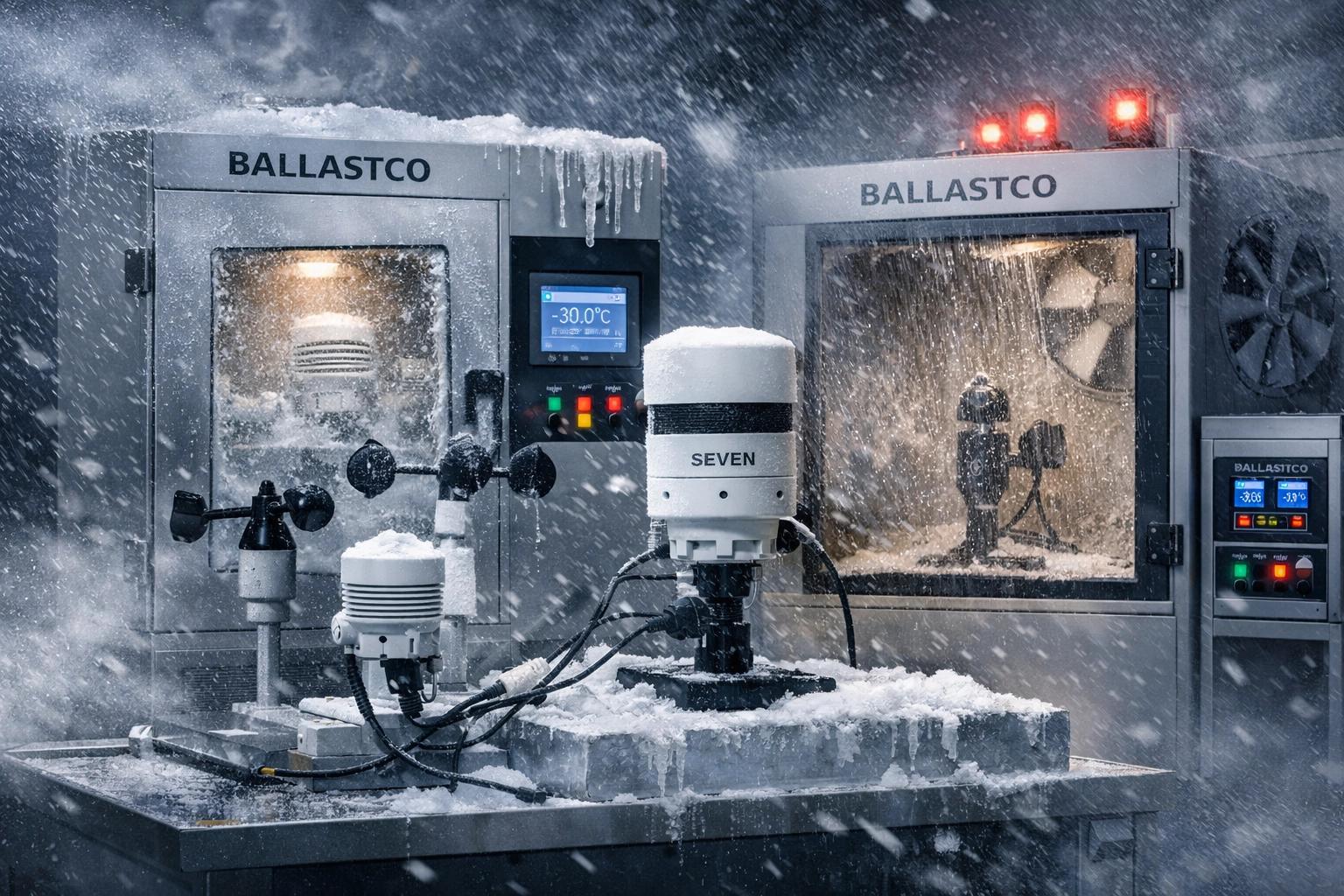
Meteorological sensors used in solar power plants (SPPs); such as pyranometers, irradiance, temperature, and wind speed/direction sensors, etc. are continuously operated outdoors. These sensors are exposed to harsh weather conditions such as UV radiation, temperature–humidity cycles, heavy rain, and strong winds. To identify the effects of such exposure before field deployment, test chambers are used. Test chambers make it possible to simulate these harsh conditions in the laboratory in advance and to reproduce the same conditions repeatedly.
In this regard, field conditions are simulated using BallastCo Test Chambers, accelerating the results."
BallastCo Test Chamber Solutions
The following BallastCo chamber solutions directly target the most common
field risks in products and offer users early error detection:
1. Climate Chamber
Temperature fluctuations cause drift in electronic, mechanical, or optical components. Changes in humidity increase the risk of condensation and corrosion. Climate test chambers create these conditions in a controlled manner, enabling the observation of the effects of temperature and humidity on the product.
BallastCo Climate Chamber enables critical environmental tests with a temperature range from -40°C to 120°C and a humidity range of 20%-90%. The Climate Chamber provides early results for design validation, initial prototype tests, intermediate checks during mass production, and pre/post-test calibration difference analysis.
2. UV Test Chamber
Meteorological sensors are often exposed directly to sunlight. UV radiation
can cause embrittlement of the housing material and wear of sealing elements.
On optical surfaces, it may lead to reduced performance and visible changes
such as discoloration.
BallastCo UV Test Cabine
focuses on measuring UV durability with programmable UV lamps,
timer-controlled test cycles, homogeneous light distribution, and precise
temperature-humidity settings.
3. BallastCo IPX5/IPX6 Water Ingress Test Device
One of the most critical failure causes in outdoor sensors is water. This
occurs due to water ingress resulting from insufficient IP protection of the
sensor. IP tests standardize the product’s resistance to water spray. The IP
rating is a coding system defined under IEC 60529 that specifies the degree of
protection against the ingress of dust and liquids.
BallastCo IPX5/IPX6 Water Ingress Test Device is offered as a solution integrated with an adjustable flow rate and rotating table. Technical specifications include a flow rate of 12.5 L/min for IPX5 and 100 L/min for IPX6, with a stainless steel, leak-proof structure.
4. High-Precision Wind Tunnel System
The accuracy of wind speed and direction sensors cannot be explained by
electronics alone. How clean and stable the airflow is also directly affects
the result. Therefore, in R&D testing, a low-turbulence flow field that
provides the same conditions every time is very important.
BallastCo High-Precision Wind Tunnel System
is specified with the following features:
- - Airspeed: 0.4–45 m/s
- - Turbulence ratio: <1%
- - Transparent test chamber: 60x120x60 cm
- - Fan power: 18.5 kW (52,000 m³/h)
- - Stainless steel flow correction mesh
- - Silencer for quiet operation
- - Entry cone and diffuser system
- - 380V electrical connection
- - Adjustable speed values
Test Devices for R&D and Quality Teams
- - Climate Chamber is used to assess products’ resistance to temperature and humidity conditions and to perform drift analysis in long-duration tests.
- - UV Test Chamber is used for UV aging, evaluating risks that may occur in optical components, and examining visual changes.
- - <IPX5/IPX6 Test Device is used to check sealing against water and similar liquids and to verify the IP protection level.
- - Wind Tunnel System is used, especially, to validate the performance of wind sensors under different flow conditions.
BallastCo's Calibration Laboratory was established by ArGeSim in 2022. In its calibration activities, it aims to meet the requirements of TS EN ISO/IEC 17025. Accordingly, an accreditation application was submitted to TÜRKAK in 2025.
Additionally, BallastCo offers high-precision calibration services for thermopile pyranometers, irradiance sensors, and wind speed and direction sensors.
Frequently Asked Questions
-
Q1: What is the main difference between IPX5 and IPX6?
The main difference between IPX5 and IPX6 is that water is sprayed onto the device with greater force in IPX6. In other words, the water jet is more “intense” in IPX6. According to the values provided by BallastCo, 12.5 liters per minute of water are used in IPX5, whereas 100 liters per minute are used in IPX6. The IP code defined in IEC 60529 already specifies the degree of protection a product has against liquid ingress. -
Q2: Does using a test chamber prove sensor accuracy?
Using a test chamber strengthens product durability, but it does not prove accuracy on its own. To ensure accuracy, calibration and uncertainty calculations must also be carried out, and measurements need to be performed regularly. -
Q3: Why is a wind tunnel preferred for wind sensors?
This is because, in wind speed and direction sensors, measurement accuracy is directly related to the quality of the airflow. BallastCo’s wind tunnel system aims to provide controlled and repeatable flow conditions, with a speed range of 0.4–45 m/s and turbulence levels below 1%. - Q4: Is technical service available for Ballastco Test Chambers?
- Yes, installation and technical service are available for all test equipment purchased from Ballastco. Please contact us for any purchase or technical information requests.
- Q5: What is the price range of the IPX5/IPX6 Test Device?
- The prices of IP test devices generally fall within the range of USD 7,000.00 – USD 12,000.00.