How Can Bubble Formation, Delamination, and Adhesion Issues in PV Cells Be Prevented?
Published:
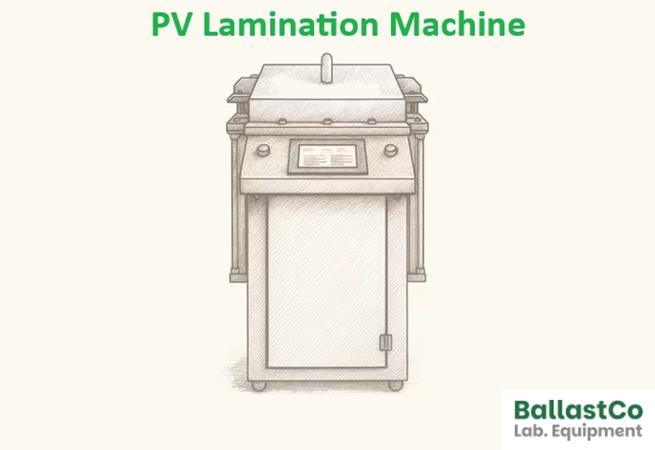
Lamination is the most critical stage in the production of photovoltaic (PV)
cells, directly affecting quality. In PV modules, it is essential that the
glass, EVA, solar cells, and backsheet or glass-glass layers are firmly bonded
together. Consequently, ensuring the cells are long-lasting and
high-performing is of paramount importance.
If vacuum, temperature, and pressure values are not properly managed during
the lamination process, bubbles may form inside the module, and delamination
and adhesion issues may occur. These problems reduce production quality.
Furthermore, these issues can negatively impact the cells’ field performance,
durability, and service life.
For this reason, using a high-quality PV lamination machine is one of the
fundamental requirements for quality in solar cell production. The
BallastCo Mini Lamination Machine, model BL-PVL-480, is precisely why it should be chosen. In this article, we will explore how
issues such as bubbles, delamination, and adhesion problems arise and how they
can be prevented.
What Is Bubble Formation in PV Modules?
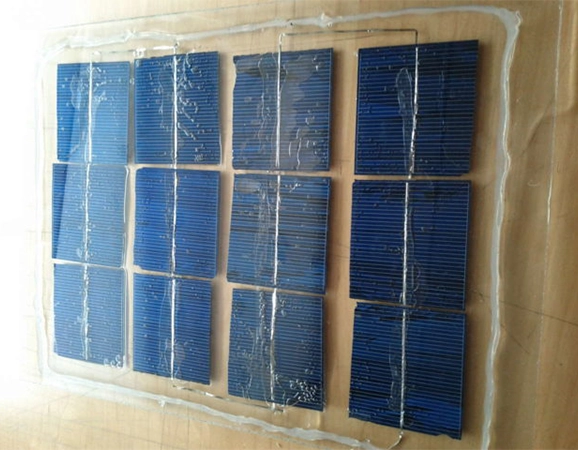
Bubble formation occurs when air pockets remain between the layers of
photovoltaic (PV) cells (glass, EVA, solar cells, and backsheet) during
lamination. These air pockets are typically caused by insufficient vacuum,
incorrect temperature settings, the use of unsuitable EVA, or improper process
duration.
Bubbles forming inside a PV module can affect both the visual quality and
technical performance of the photovoltaic (PV) cells. Over time, moisture
accumulation, poor adhesion, or the risk of damage around the cells may arise
in these areas. To prevent bubble formation, the PV cell layers must be clean
prior to lamination, the correct vacuum level must be maintained, and the EVA
curing process must be carefully controlled.
What Causes Delamination?
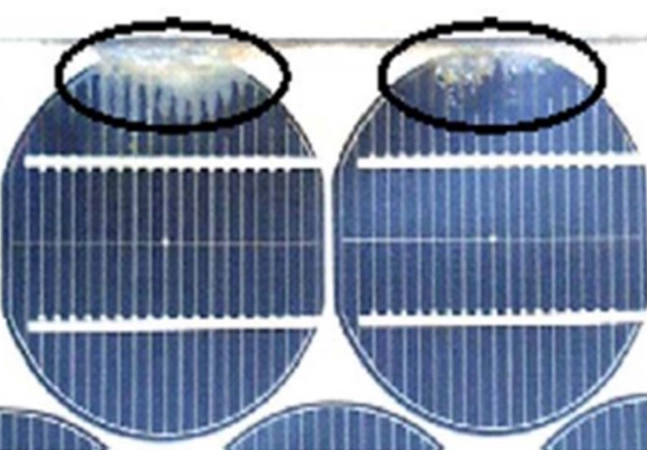
Delamination is the separation of the layers in a PV module over time. This
issue typically arises due to insufficient adhesion, poor lamination quality,
or incorrect process parameters. Solar PV cells are used outdoors for many
years. Outdoor environmental conditions such as temperature fluctuations,
humidity, UV radiation, and mechanical stress can cause damage to the cell
structure over time. Therefore, if the lamination process is not performed
correctly, these external factors can eventually cause the cell layers to
separate.
Consequently, when delamination occurs, the electrical performance of
photovoltaic cells decreases, moisture ingress increases, and the module’s
service life is shortened. For this reason, proper control of temperature,
pressure, and vacuum must be ensured during the production process.
How to Prevent Adhesion Issues?
The quality of adhesion in PV modules depends on the proper curing of the EVA
and the bonding of the layers under uniform pressure. Insufficient
temperature, a short process duration, or uneven pressure distribution can
prevent the layers from bonding to the desired extent.
To prevent adhesion issues, the following criteria must be followed:
- The lamination temperature must be set correctly.
- The vacuum level must remain stable throughout the process.
- Pressure must be applied evenly across the entire surface.
- The EVA material must be stored and used under appropriate conditions.
- The PV cell layers must be clean and dry before lamination.
These steps help create a stronger module structure and reduce long-term
quality issues.
How Does the Right Laminating Machine Affect Quality?
To prevent issues such as bubbles, delamination, and adhesion in PV modules,
every stage of the production process must be carefully managed. One of the
most effective ways to prevent bubbles, delamination, and adhesion issues in
PV modules is to use a lamination machine with precise control features. This
is because even small temperature variations, insufficient vacuum, or uneven
pressure distribution during the lamination process can cause serious quality
issues in the final product.
The BallastCo PV Laboratory-Grade Laminating Machine is an industrial
solution developed to precisely control vacuum, temperature, and pressure
parameters in solar cell production. With its high vacuum performance, precise
temperature control, powerful pressure application, and automation features,
it helps achieve more consistent results in the production process.
With its industrial design capable of adapting to various PV module
structures, the BallastCo PV Laboratory-Grade Laminating Machine offers an
efficient solution for solar cell manufacturers. Its structure, suitable for
both glass-backsheet and glass-glass module production, provides flexibility
on the production line.
This Small Laminating Machine features an automatic cover system, precise
temperature control, high vacuum performance, and is customizable. With the
BallastCo laboratory-type laminating machine, manufacturers can create more
controlled production processes for different PV cell sizes thanks to various
area options. All these features provide significant advantages, particularly
for PV module manufacturers aiming for high-quality standards.
In conclusion, the BallastCo Mini Laminating Machine is a strong investment
option for companies seeking to produce higher-quality, more durable, and more
reliable modules in solar cell manufacturing. In other words, the
BallastCo BL-PVL-480 PV Laminating Machine
is an excellent choice for reducing issues such as bubbles, delamination, and
adhesion in your solar cell production line, and for establishing a more
controlled and efficient lamination process.
Frequently Asked Questions
1) Why do bubbles form in PV modules?
They are typically caused by insufficient vacuum, incorrect temperature
settings, or air trapped between layers.
2) What is delamination?
It is the separation of PV module layers over time.
3) How can adhesion issues be
prevented?
They can be prevented by using the correct temperature, sufficient pressure,
stable vacuum, and appropriate EVA.
4) Does the lamination machine affect
quality?
Yes. Precise vacuum, temperature, and pressure control directly affect the
quality of photovoltaic (PV) cells.
5) What advantages does the BallastCo
Lamination Machine offer?
Due to its laboratory-type design, it offers space-saving benefits. It
provides high vacuum performance, precise temperature control, a PLC system,
and compatibility with various module structures.
6) What is the price range for the
BallastCo Mini PV Laminating Machine?
The prices for
BallastCo Mini PV laminating machines
generally range from 5,000 to 10,000 USD.